

Was he two-faced?
Or just deeply conflicted?
We’re about to enter the month when Americans celebrate their presidents—not all of them, of course, mainly two of the most revered who happened to be born in the same month, 77 years apart.
We honor Abraham Lincoln for guiding the nation through its “fiery trial,” as he called it, and for liberating enslaved people.
George Washington, “Father of Our Country,” is venerated for his Revolutionary War leadership and for setting early benchmarks of ethical conduct and selfless service as our first president, qualities that are, shall we say, less steadfast these days.
Yet amid all the praise for Washington’s character and civic virtue, one fact often receives less attention: He owned slaves. Hundreds of them.
In Washington at the Plow: The Founding Farmer and the Question of Slavery, historian Bruce Ragsdale explores the complicated intersection between Washington’s zeal for agricultural innovation and his dependence on enslaved labor.
After Britain’s surrender in 1783, Washington returned to Mount Vernon following eight years away. He threw himself into improving American farming, studying new techniques like crop rotation and the use of manure as fertilizer. Wheat replaced tobacco as his main crop, joined in rotation by barley, turnips and pastures. Working his 11,500 acres were roughly 300 enslaved men, women and children.
For Washington, agriculture shaped how he understood slavery. When a friend sought his advice on purchasing slaves, he replied, “I do not like even to think, much less talk of it.”
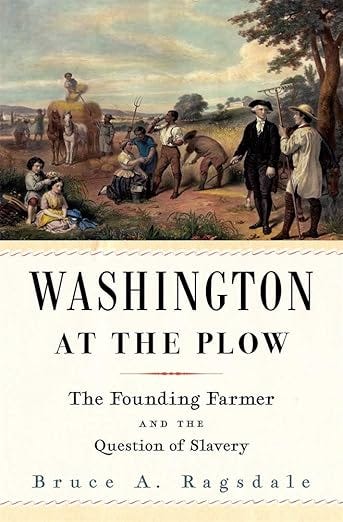
The question became harder to avoid during the Constitutional Convention. As president, Washington privately considered emancipation but hesitated. His experimental farms still depended on enslaved labor. Only in his will, written five months before his death, did he order that his slaves be freed upon his wife death. Martha carried out that wish in early 1801, 17 months after his death and 17 months before her own.
Ragsdale observes that Washington “could not escape the implication that his ownership of slaves violated many of the fundamental principles of the American Revolution on which his reputation rested.”
It’s fair to say his economic interests prevailed, leaving a festering contradiction that Lincoln would confront generations later.
Still, there is this: Of all the Founding Fathers, only George Washington freed his slaves. Something to consider as we approach President’s Day and Black History Month.
Stepping back
Interested in time travel? Then step back a decade and check out an eight-part mini-series now streaming on Netflix: “11.22.63.”
Based on Stephen King’s novel of the same name, the series stars James Franco as a high school teacher who’s introduced to a portal to the past and becomes persuaded to use it to stop the assassination of President John F. Kennedy. But altering history, as he soon learns, is anything but easy.
The JFK storyline takes its time unfolding. The second episode’s burst of violence—when Jake tries to stop a multiple murder—is jarring, but beyond that, the narrative settles into a deliberate, engrossing rhythm.
As a period piece, “11.22.63” earns an A+. Classic car enthusiasts will be in heaven. Every street scene teems with beautifully restored sedans from the ’40s, ’50s and early ’60s. (Jake begins his time travel in 1958—two years earlier than in King’s novel.)
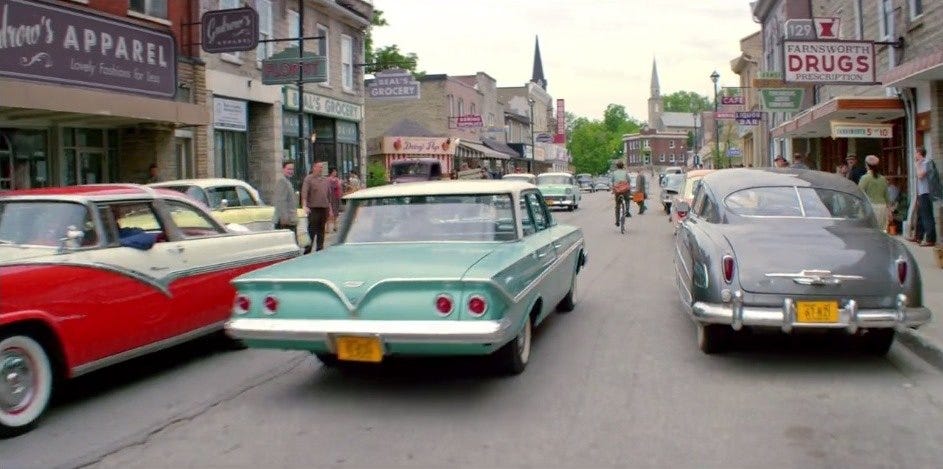
Many critics rank this as the best Stephen King screen adaptation, and it’s easy to see why. The series is thought-provoking, suspenseful, sometimes heartbreaking and, yes, loaded with Bel Airs, Ambassadors, Larks and Impalas.
I was going to insert a joke here about time-travel, but you guys didn’t like it.
Now hear this
This aging, mostly retired voice from the past wandered into an Arizona recording studio late last year and spent parts of four days reading his own words aloud, one raspy syllable at a time. The result (despite distractions involving microphones, cough drops and unshakable longing for afternoon naps) is the audio version of what I’ve called an “almost memoir”—Broadcast Live: 71 True Stories, Including Some I’d Just as Soon Forget. The audio version was “published” last week.
To those who’ve already listened—voluntarily, even—and offered kind words, my sincere thanks. You’ve shown impressive patience (and, perhaps, a morbid curiosity about what I sound like these days).
Speaking of heartfelt thanks: Wow, do I owe a big one to everyone who’s taken time to post a review. Thanks to you, Broadcast Live is somehow holding steady at a frankly unbelievable 4.8 out of 5 stars on Amazon. (I keep checking to make sure it’s not a clerical error.)
If you’ve read or listened and found the experience at least marginally less painful than a root canal, I’d be deeply grateful if you’d add your voice to the chorus with a quick review on Amazon, Goodreads, Barnes & Noble, or wherever you hang out online.
Every star and sentence helps more than you know—and might just keep a fragile author ego afloat for another day or two.
The audio book is available through all the usual places, possibly even free through your local library. (Did I mention audio books are easy on the eyes?)

Sky-high ambition
It was 68 years ago today that the U.S. entered the Space Age with its first successful launch of a satellite, Explorer 1.
You remember that? Wow, then you’re also old enough to remember—or at least heard about—Wildroot Cream Oil, Sputnik and poodle skirts. And that causes me to think you’ll enjoy a memoir I’ve belatedly discovered.
Rocket Boys by Homer Hickam, Jr., a National Book Critics Circle Award nominee when it first appeared 27 years ago, inspired the movie “October Sky,” which I now plan to track down.
Hickam tells how he and his high school buddies captured the imagination of their fading West Virginia coal town by building and launching increasingly ambitious rockets. Yes, rockets!
As someone who barely survived algebra—never mind trigonometry, physics or calculus—I was awestruck by these kids’ self-education and ambition. They eventually earned a national science fair medal for their efforts, though not before “borrowing” a mom’s toaster heating element, firing off a few dangerous projectiles and daring to dream of futures beyond the dangerous coal mine that dominated their fathers’ lives.

The story intertwines several threads: a father’s stern pride as the mine superintendent, a mother’s quiet encouragement of her son’s unlikely dream, a teenage romance or three, and a football team that holds the town together—until it doesn’t.
Hickam went on to become a NASA engineer who can tell a story that both moves and inspires.
Just sayin’
In my last month-end Substack, I called “The West Wing” some of the best TV ever made. We just finished our Netflix rewatch of Season Two, and it’s unnerving how many of the “issues” faced by that fictional White House of 25 years ago still smolder in the real one.
And there’s Episode 16, where members of “The Organization of Cartographers for Social Equality” visit the West Wing to demand schools dump the traditional classroom wall map in favor of the Peters Projection (below).
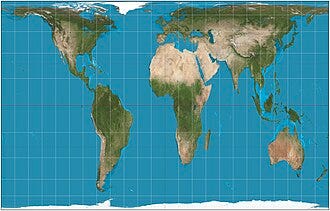
Turns out the familiar and flat Mercator map doesn’t just chart geography—it distorts it, making northern nations look grand and shrinking the Global South to afterthoughts.
A very timely for-instance: In the common map, Greenland appears roughly the size of Africa, despite Africa actually being 14 times larger in area. Who knew?
Not Donald Trump, I’m betting.
Maybe someone should cue up “The West Wing” for him between UFC fights and Truth Social tantrums. He might learn something about the world, or at least how a president is supposed to act when handed a map.
Thanks for reading.
well done -- I appreciated your President's perspective. Yesterday (Friday), Dr. Stephanie Fortado and I did a presentation for ISU's statewide Social Studies - History Teachers symposium, on the Working Class & 1776. And of course, enslaved people are part of the working class. In our power point, Stephanie did a great job finding source material websites we could send teachers to - I can send you the slides if you wish. Great comments on the map and the distortion that the maps we grew up do to the planet's true perspective, and you asked a great question, is DJT remembering his grade school, or does he have current intellegence?