

Surgery needed, a century of flyers and staying in step...
Radio Farda
There was a remarkable moment on Capitol Hill last week that demonstrated the folly of the Trump administration’s meat-cleaver approach to curtailing federal spending.
Iran shut down citizen access to the internet just as its 90 million people hungered for news about their country’s conflict with Israel. Meanwhile the Trump appointee in charge of the Voice of America was demanding that lawmakers defund it, calling her agency “a rotten piece of fish.”
Based on Trump’s executive order, Kari Lake had already greatly curtailed the short wave radio broadcasts into Iran by Radio Farda. That’s the Kuwait-based Persian language service funded by our government. Its old analog technology overcomes web-based censorship and provides the oppressed the information they desperately need and seek out.
Can waste and savings be found inside our agencies, even those designed to disseminate information to countries with limited press freedom? Of course. But let’s take a surgical approach to cost-savings and not be stupid about it.
Up in the air
A fascinating article by Laurie Gwen Shapiro in The New Yorker this month explores whether a relentless pursuit of publicity by aviator Amelia Earhart’s husband propelled her to make increasingly risky flights, including her fateful effort to circumnavigate the globe.
That story’s description of the era’s aviation made me especially eager to pick up Prairie Flyers of Central Illinois, a book co-authored by my The Unforgiven co-author, Edith Brady-Lunny.
This new book is an outgrowth of a Clinton, Ill., museum exhibit detailing the remarkable number of people from a small Illinois county (DeWitt) who’ve been, as the authors proclaim, “infected by the aviation bug.”
The symptoms are clear, they write. “They swing in a backyard swing and daydream about flying. They build model airplanes. They lie on their backs in the yard and study the clouds. At the slightest sound from aloft, they scan the sky like they’re looking for a lost dog. They follow every airplane news story, devour every book and magazine about flying, loaf around at airports and talk about airplanes to anyone who will listen.”
There were local people in the skies over DeWitt County a hundred years ago back when there were no regulations about who could fly or about how planes were maintained.
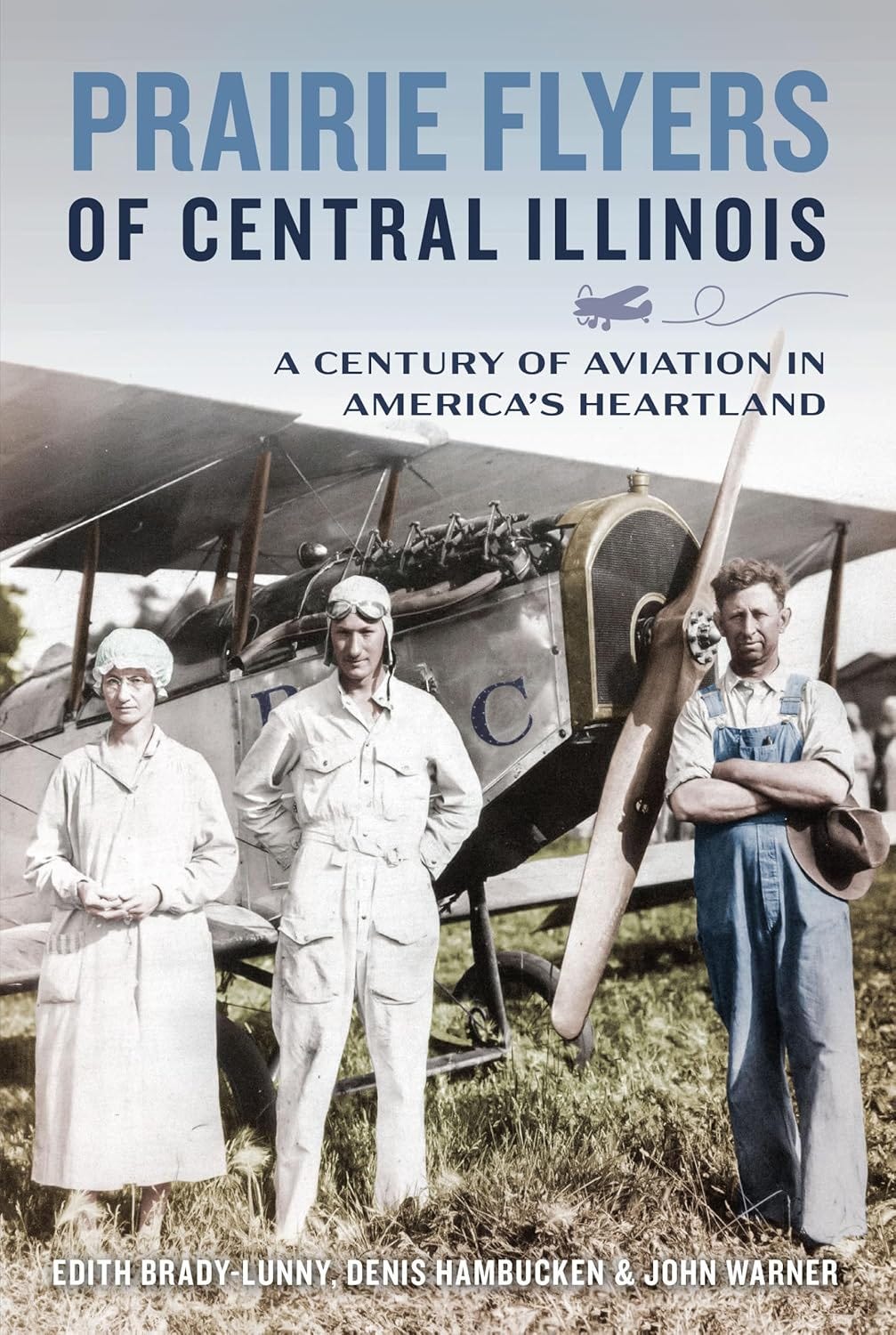
We learn about four dozen individuals, many of them who got their wings and some who lost their lives in World War Two. But we also meet aerospace engineers, a UPS pilot, defense contractors, smokejumpers and a hot air balloonist.
There’s the veteran of 35 combat missions over Germany who “stretched the boundaries of aviation and farming by planting a crop of soybeans by air.”
In this photo-rich book, we meet DeWitt County’s first and youngest aviatrix who, as a teen, was part owner of a plane and assistant manager of an area airport and later worked at an area plant that produced a part for the first atomic bombs. There’s an Army helicopter pilot who flew for the CIA and a former Marine who walked away from his job piloting tourist helicopters over Hawaii because the choppers “may have benefited from more extensive mechanical checkups.”
“There are two types of pilots,” the authors write, “—bold pilots and old pilots—but there are no old, bold pilots.”
If you’ve ever had the aviation bug, are interested in Illinois history or would like to discover the impact the use of castor oil as an aircraft engine lubricant had on certain pilots, Prairie Flyers of Central Illinois is for you.
The Green-Wood connection
Hang with me on this. In the very same New Yorker issue that contains the Earhart feature, there’s another story that links its way to Clinton and DeWitt County, Ill.
It’s about Green-Wood, a privately-owned, 478-acre cemetery laid out in Brooklyn, N.Y., in 1838.
It seems its owner had a hard time getting it off the ground, so to speak. In its first five years, only 175 burials had occurred there. What to do to ensure its commercial success?
Turns out DeWitt Clinton—yes, the namesake of the county and small city so important to Edith’s aforementioned book, the governor of New York who had pushed for construction of the Erie Canal and suddenly died in office—had been laid to rest in a borrowed vault in the state capital of Albany because his family was too poor to get his body back to New York City where he’d been mayor.
So 22 years later, in 1850, Green-Wood offered a free permanent burial spot marked by a suitable bronze statue—10 feet tall on an eight foot pedestal, showing Clinton wearing both a business suit and a toga.
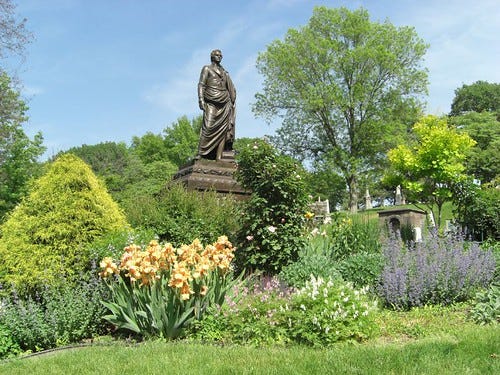
“Green-Wood had less trouble attracting clients after that,” Shapiro writes. Tiffanys, Pfizers, Henry Ward Beecher, James Gordon Bennett, Sr., Horace Greeley all found their way there. Monument carvers and florists set up shop in the neighborhood.
Today nearly 600,000 people are interred in Green-Wood and it’s a National Historic Landmark.
Clinton, Ill., by the way, was founded seven years after DeWitt Clinton’s death and three years before Green-Wood opened.
Left, left, left-right, left…
Last month I noted that as a U.S. Army veteran, I felt empowered to find something other than the Army’s 250th birthday or Donald Trump’s 79th birthday to celebrate on June 14th. I discovered it was, remarkably, National Cucumber Day. Cool!
I nevertheless felt compelled to watch large portions of the televised event—partly because I really do love parades and fireworks, and partly because I wanted my own assessment of just how grand or grotesque the occasion would be.
Trump started talking eight years ago about wanting to have his own big military parade after he had a front-row seat at France’s Bastille Day parade, a grand, annual event.
Trump probably doesn’t know the July 14th date marks rebels’ storming of the Bastille prison in Paris, launching the French revolution. But he almost certainly has seen images of the massive military parades in China and North Korea. If he was hoping for the same kind of meticulously choreographed event in the District of Columbia, he was surely disappointed.

I’m definitely old-school military, remembering the first thing you learned in basic training was how to march in formation (“Your other left, Vogel!”) So I fully expected the troops that paraded past the president and his loyalists in mid-month would have been feverishly drilled, practiced and polished. Military manner and bearing on-parade!
Uh, not so much.
Even a couple West Point cadets in their full Dress Grays marched out-of-sync. In some other units dressed in battle fatigues, it was hard not to notice an occasional soldier out of step—enough to make me wonder whether some of it was intentional on the part of a troop unhappy over the parade’s politicization.
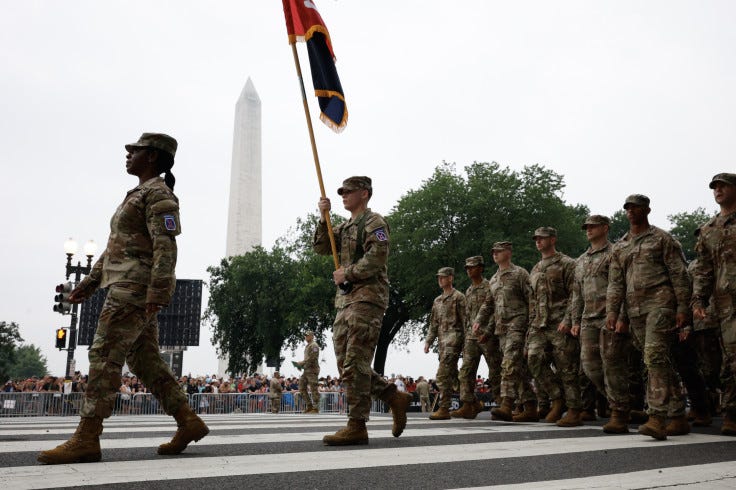
In North Korea, being out-of-step is probably career (if not life) ending. It would be interesting to know if the lackadaisical demeanor June 14th resulted in any marchers or their leaders facing repercussions. A little hard to defend, I suspect, when the commander-in-chief nodded off.
Okay, cut the 79-year-old a little slack. A demanding travel schedule, a long parade and a couple birthday double cheeseburgers might put the drowsies on all of us.
A compassionate Trump?
And the moment was so unusual—maybe unprecedented—that it warranted stand-alone stories on more than a few media outlets.
It happened during a news conference at last week’s NATO leaders summit in the Netherlands. A female reporter who covers her native Ukraine for the BBC asked Trump, “whether or not the U.S. is ready to sell anti-air missiles to Ukraine.”
Trump asked her, “Are you living, yourself, now in Ukraine?”
“My husband is there,” she answered. “And me, with the kids, we’re in Warsaw, actually, because he wanted me to. “
“Is your husband a solider?”
“He is.”
“He’s there now? That’s rough stuff, right? That’s tough,” Trump observed.
That’s empathy I’ve never seen from Trump. Maybe one of his trusted loyalists found a way to tell him, “You don’t have to be an ass all of the time.”
This day forward…
Fellow (and a favorite) Substacker Dr. Mardy Grothe recently used a brief quotation from theologian Frederick Buechner to remind us there's no day like today.
"Today is the only day there is," Buechner wrote in Whistling in the Dark. "The point is to see it for what it is, because it will be gone before you know it."
With that in mind, you're going to see me posting more frequently on Substack--sometimes long, sometimes short, sometimes directly related to the day's events, sometimes something that may seem familiar.
I hope there's curiosity and anticipation each time my name shows up on your device, that you’ll read my post and maybe even be inspired to like, restack, comment and share with a friend.
As always, thanks for reading!
"'Your other left, Vogel.'" I appreciate your ability to slip in a little self-deprecating humor. I consider self-deprecation underrated, and if I were clever enough, this would be the spot where I'd indulge in it myself.