

Reckless with a capital R
I just gotta say it:
Donald Trump stands as the most reckless president in American history.
Just as worrisome is that he very possibly knows he’s out of his depth, but he so loves the global attention he can demand because we’ve imposed a self-absorbed autocrat on the world.
Trump’s trademark is noise, swagger and a constant stream of lies. He doesn’t lead; he performs. He has turned the presidency into a gilded reality show. He mistakes bluster for strength and leaves behind a trail of chaos while pretending it’s all part of some grand master plan.
Yes, he’s dangerously reckless. And while there may have been some equally shameless and rudderless presidents in America’s past, they didn’t have their own social media accounts to sow overnight chaos.
The millions who turned out for last weekend’s “No Kings” rallies should help stiffen the spines of at least a few Republicans. Congress needs to re-assert itself before our democracy is further diminished.
Hot, hot, hot
This month-end Substack again comes to you from suburban Phoenix, where triple-digit heat scorched the desert even as the calendar insisted it was still winter. Records fell like dominoes in a dust storm, underscoring new research that shows global warming’s pace has nearly doubled in the past decade.
To put a finer point on it: Nearly every day this month set a record high for Phoenix—often 10 or 15 degrees above the old mark. Even the overnight “low” of 72 degrees earlier this week broke the record for warm nights. And remember, this is the city that only two years ago endured 113 straight days above 100 degrees.
Yet the Trump administration acts as if global warming were a minor inconvenience, rolling back rules that would make companies measure and report vehicle emissions. It continues to champion coal, oil and gas while stalling progress in wind and solar.
This cactus is blooming like crazy in our backyard—something unseen before these record highs. Maybe it’s trying to tell us something.

Maybe it’s trying to tell us that climate change isn’t a distant threat anymore.
It’s right here, right now.
History can feel personal
There were several reasons I was eager to see the new film Nuremberg when it finally showed up on Netflix this month.
I spent half of my two-year Army hitch in Nuremberg, broadcasting for American Forces Radio from a building once prowled by Hitler himself. (More about that part of my life—plus an episode that’s prompted some friends to say, “I’m not sure I’d have written about that!”—can be found in Chapter 28 of Broadcast Live.)
That same chapter introduces Inge Geier, a German national who served as AFN-Nuremberg’s secretary for parts of four decades. She began her career as a translator at the Nuremberg war crimes trials. Each day on her way to work at AFN, she passed the Palace of Justice, the trials’ venue. The building had escaped heavy damage from Allied bombing of Nuremberg. Its use carried powerful symbolism: The Nazis’ ceremonial capital now stood as the stage for their reckoning.
And my final, six-degrees-of-separation reason for watching the movie? The father of a grad-school classmate had been an assistant prosecutor at those very trials.
It’s hardly the first time filmmakers have tackled Nuremberg. The 1961 “Judgment at Nuremberg” was fictionalized but strong; the 2001 made-for-TV two-parter, “Nuremberg,” stuck closer to the facts and delivered a taut courtroom drama.
This new version centers on the uneasy relationship between Hermann Goring, played with chilling charisma by Russell Crowe, and an Army psychiatrist assigned to assess the mental health of the Nuremberg defendants. Two other top Nazis, Heinrich Himmler and Joseph Goebels, had already taken their own lives.
Oscar winner Rami Malek is cast as the psychiatrist forced to confront evil in 22 jail cells. The film revolves around his shifting rapport with the vain, manipulative and utterly unrepentant Goring.
You’ll want to avert your eyes when film used to document the horrors of the concentration camps is shown as evidence. But maybe you shouldn’t.
Late in the movie, the psychiatrist’s translator (played by Leo Woodall) offers a line that lands hard.
“You want to know why it (the holocaust) happened here? ‘Cause people let it happen. ‘Cause they didn’t stand up until it was too late.”
It’s a reminder that still hits uncomfortably close to home.
And history rhymes
Then imagine my surprise when the first book I opened after watching “Nuremberg” was haunted by the same trials.
Mark Braude’s The Typewriter and the Guillotine begins with France’s last public execution and, in an Erik Larson–like fashion, threads together the dramas that unfolded as Europe slid toward World War II.

At its center stands Janet Flanner, the American correspondent in Paris who helped shape The New Yorker magazine in its infancy. She had covered Lindbergh’s landing and, just as Nazi tanks rolled into Czechoslovakia, the French trial of a German national accused of killing six people—two of them Jews.
For years, though, Flanner specialized in breezy sketches of Parisian life. “She did as much as anyone to shape popular conceptions of Paris,” Braude observes. But that focus changed after she witnessed a Nuremberg rally of hundreds of thousands under 21,000 fluttering swastikas. To her, Hitler looked like “a surprised messiah, astonished at his holy success.”
Later, she described Austrians gazing at the Nazis’ vile “Eternal Jew” exhibition—faces, she wrote, like “pagans watching Christians thrown to the lions.”
Flanner’s three‑part New Yorker profile of Hitler opened with a mordant jest: How strange, she mused, that a man who neither drank, smoked, ate meat nor apparently slept with women ruled a nation famed for beer, cigars, sausages and women. She found Hitler’s mind “limited,” his face “inappropriate to fame,” yet acknowledged his gifts as a “mob orator” with “furious energy.” What some readers took as mildness, Braude interprets as warning.
Flanner left Europe just before the Germans invaded Poland and didn’t return until after Paris was liberated. Then came her visits to the concentration camps and the Nuremberg trials.
She had planned to attend for a single day but stayed long enough to write three dispatches for her weekly as the word “genocide” entered public speech. Her reports did not spare readers. She described photos of atrocities the Nuremberg film (wrenching in their own right) had wisely softened—images of men and women devoured by dogs and pigs while bystanders laughed.
Braude says he wrote this book “to capture the brutality of the era—and the strength people summoned to survive it, as they fought to maintain some measure of civility while watching civilization fold in on itself.”
But one passage arrested me:
“Because Hitler stood so far beyond the pale of what a normal leader looked like,” he writes, “no one was qualified to understand what he wanted in exchange for peace, nor what might spark him toward waging a full war.”
That, I couldn’t help thinking, sounds eerily familiar.
The microphone falls silent
A friend once gave me a tour of the CBS News headquarters in Manhattan, and for a brief moment I sat in the chair before the microphone from which thousands of CBS Radio newscasts had been delivered.
I swear I could feel the authoritative presence of Douglas Edwards and Dallas Townsend—and maybe even Edward R. Murrow—in the air.
A few minutes later, I met a man whose baritone voice I’d known for years, but whose astonishingly thick glasses caught me off guard. It was Christopher Glenn, another of the anchors who helped define radio journalism for decades. For most of the 20th century on into the 21st, nothing on radio matched the rigor and reliability of CBS Radio’s top-of-the-hour newscasts. Here’s the “sounder” that began them for many years:
Now that legacy is nearing its end. The beleaguered CBS—today a small division of Paramount Global, which appears about to absorb CNN as part of its purchase of Warner Bros. Discovery—plans to shut down its radio news service that still supplies news to about 700 stations nationwide. The final broadcast is scheduled for May 22, just 16 months short of the network’s 100th anniversary.
As longtime industry observer Michael Harrison put it, “This is another part of the landscape that has fallen off into the sea.”
Familiar voices also fall silent
Two giants of Chicago radio—both prominent during its greatest decades—died within hours of each other this month.
John Hultman was more than a colleague; he was a friend who opened many doors for me.
In Chapter 36 of Broadcast Live, I describe how friendships Mary formed with wives of other news directors at broadcasters’ meetings led to my connection with some of the biggest names in larger markets. John was one of them.
When he stepped down as news director at WBBM Radio in Chicago, John could no longer serve on the board of the Radio-Television News Directors Association. He recommended me as his successor—a gesture that shaped the next chapter of my career.
I went on to serve about eight years on the RTNDA board, experiences that ultimately led to a decade as a judge for the William Randolph Hearst collegiate journalism awards and to my role on the team that awarded Arizona State University’s Walter Cronkite School of Journalism and Mass Communication its initial accreditation.
Those opportunities were deeply rewarding for both Mary and me—a reminder of how the right introductions can lead to lasting professional and personal growth.
John was a great broadcast journalist who helped launch the then CBS-owned WBBM’s all-news format in 1968 and served as a trustworthy, familiar morning news anchor there for decades. And—lucky for me—a helpful friend. John was 89.
Also leaving us this month was 91-year-old Orion Samuelson, an agri-business broadcasting pioneer whose career spanned a dozen U.S. presidents. He interviewed most of them.
Chicago radio powerhouse WGN was Samuelson’s home base, but he was nationally known because his reports were also heard or seen on many dozens of radio and TV stations across the country. The “Big O” retired five years ago.
Both men, talented journalists with rich radio voices, left lasting imprints on their craft. I can still smile as I hear John say “News Radio 78” (he hated it when station marketers later changed WBBM’s moniker to “News Radio 7-80”). And we’ll never forget “Big O” reminding us that “If you eat, you are involved in agriculture.”
Revisiting the Lockmiller investigation
My The Unforgiven co-author, Edith Brady-Lunny, is among those featured in a new documentary examining the investigation into the 1993 murder of Illinois State University student Jennifer Lockmiller.
“Who Killed Jennifer?” premieres one week from today on the WGN+ app.
Lockmiller was 22 when she was found brutally murdered in her apartment. Two years later, her ex-boyfriend, Alan Beaman, was convicted and sentenced to 50 years in prison.
Thirteen years after that, the Illinois Supreme Court overturned his conviction. Seven years later, the governor granted Beaman a full pardon on the grounds of actual innocence. He ultimately received a $5.4 million settlement from a civil lawsuit over the handling of his case.
According to WGN, the documentary will reveal “new information about the police investigation.” You can watch the trailer here: ‘Who Killed Jennifer?
A tale of two drum kits
When Ringo Starr’s Ludwig drum kit—the one he played on “I Want to Hold Your Hand” and during the Beatles’ first appearance on “The Ed Sullivan Show”—sold at auction this month for more than $2 million, it got me thinking about my own long-lost drums and their flimsy brush with fame. Here’s the story.
Just as Beatlemania was starting to sweep America, I had begun drumming out of boredom. My last-period study hall in high school coincided with band rehearsal, and one afternoon I wandered in to watch. The director mentioned they could use another percussionist. I could read music, so why not? I started with cymbals and bass drum, graduated to timpani and snare soon after.
Not long later, I spotted a used drum kit for sale in the newspaper classifieds. Dad drove me to see it at a handsome house with tall white columns. Its owner, it turned out, had recently run an unsuccessful campaign for Congress. The drums were his son’s: a green sparkle, four-piece Gretsch set that had been sitting in the attic, waiting for a new owner. We paid, as I recall, $400.
Before long, I was drumming in a newly-formed rock band called “The Kommotions.” We played guitar-heavy standards at high school and summer-time street dances, rarely venturing more than 30 miles from home. No, that’s not the drum kit’s claim to fame.
Here’s the connection: The previous owner was Michael Laughlin, who went on to become a respected Hollywood director, producer and screenwriter. Perhaps more notably, he was married for 11 years to French actress Leslie Caron, the Golden Globe and Emmy winner discovered by Gene Kelly.
Caron was eight years older than Laughlin. In her memoir, Thank Heaven, Caron says Laughlin was “a talent scout at heart” with “a flair for discovering new faces and for predicting the coming fashion.” Their marriage ended in 1980.
Caron, now 94, divides her time among Paris, New York and London. Laughlin died of COVID five years ago at 82.
As for that green sparkle drum set, I think we let it go for a couple hundred dollars while I was in college. I like to imagine someone is still banging away on it and that one day they’ll stumble across these words, maybe even give it a few respectful beats for the memories and tiny bit of stardust it holds.
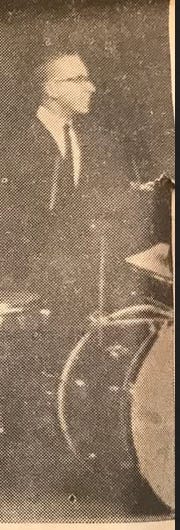
Yes, that’s me on the drums. Yes, we played “I Want To Hold Your Hand.” And yes, I tried to mimic Ringo when we played it.
The Beatles wig completely covered that “flat top.”
Thanks for reading!
Thanks for another great newsletter. I especially enjoy the photo of the well dressed drummer.