

Memory, meet hometown
The pull of the past
What would it be like to speak about my life at the very place where so much of it was shaped?
I was about to find out.
I’ve been talking quite a bit lately to groups about my “almost memoir” and gratified by how warmly people have responded. My stories seem to resonate, often jarring loose memories from their own lives, some they don’t want to forget, occasionally others they quietly try not to remember.
I suspected my visit to my Woodford County, Ill., hometown of Minonk might stir something deeper.
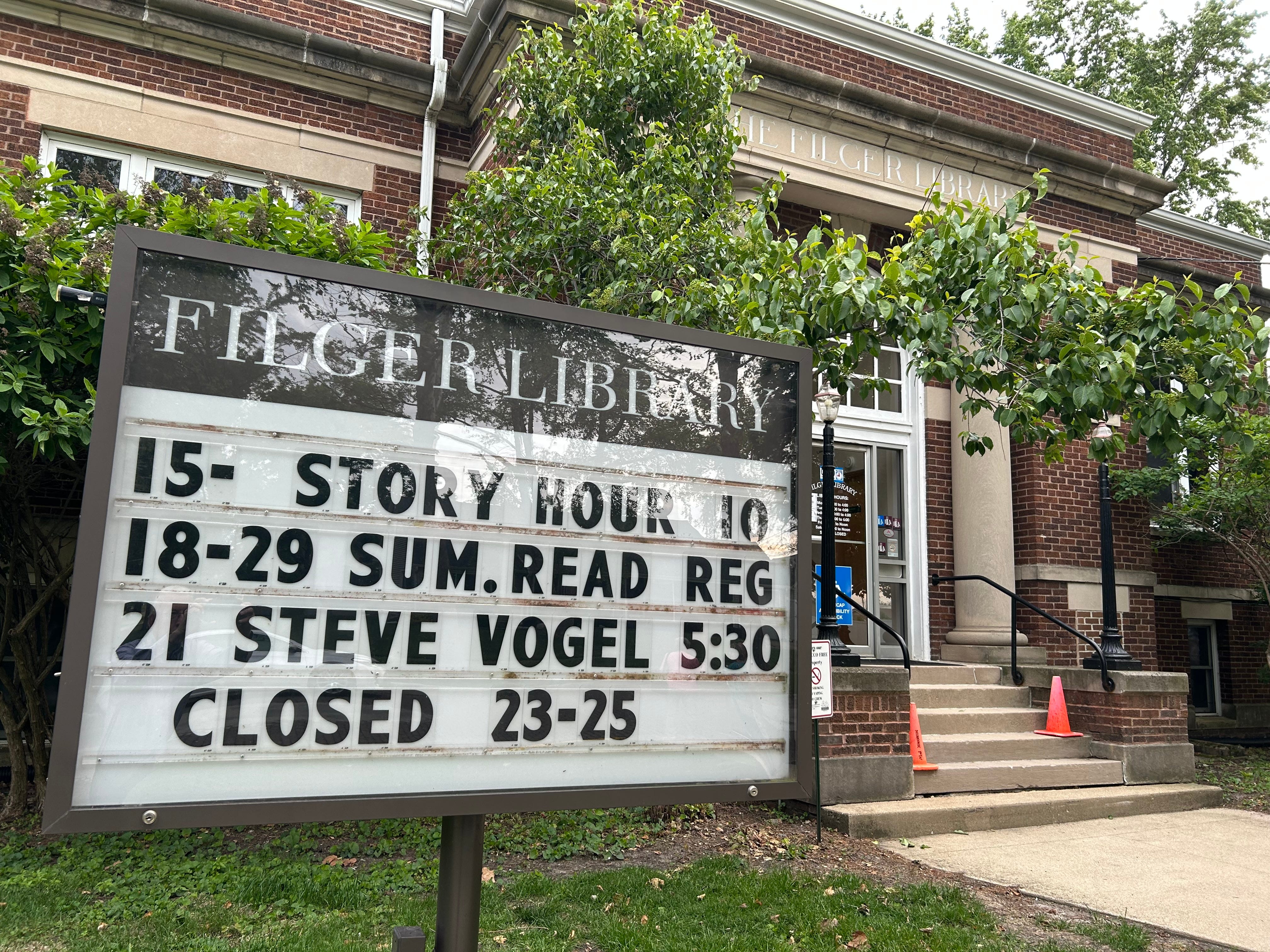
The Filger Library sits at the corner of Locust and Fifth. It’s pretty much “ground zero” for much of my early life, just a couple blocks from the two schools where I spent 12 years in a classroom.
My aunt’s house stood just up Locust, an easy walk to the library whenever I came to visit. Across the street from her house was the stately home that served as the convent for the four nuns attached to St. Patrick’s Grade School. (See Chapter Three). I took my first violin lessons in the front room of that house. And Fifth Street was the route I sprinted each day at the start of my high school lunch period, racing to my noontime job of taking orders and delivering food at Tink’s Restaurant (see Chapter 17).
Mary and I had joked about the “over/under” for attendance for my library talk. I set it at six, though privately I was hoping for at least a dozen.
Years ago, U.S. Route 51 ran straight through the center of town, shadowed by the Illinois Central rail line. Both have long disappeared, erased from the landscape. Now we took the lone exit off the interstate. It leads into the north side of town.
I recognized the old grocery building where I once worked for a dollar an hour and, through my unknowing mistake, saddled the store with a huge surplus of margarine it was still discounting months after I left (see Chapter 22).
We passed the funeral home that buried my father, then my aunt’s house. It seemed to wear its years lightly. Across the street, the former convent still stood. I wondered what use was now being put to the tiny room that was the sisters’ chapel.
At the library, I was relieved—and a bit astonished, really—to find five dozen people filling most every available chair. I immediately recognized my cousin Gloria. In many of the other faces, there flickered something just out of reach: traces of people who had once been part of my life, now older and, like me, altered by time. Yet they were not entirely unfamiliar.
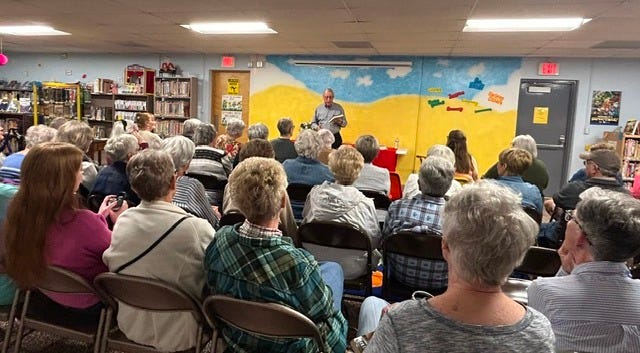
I began with a brief explanation of why I’d written Broadcast Live, then read Chapter Seven—my account of Saturday nights in downtown Minonk, before and after televisions became ubiquitous in area homes and “Gunsmoke” became appointment TV.
There were knowing nods, smiles and laughter as I described my well-worn circuit: the soda fountain at Schmidt’s Drug Store, both “dime” stores and the ritual inspection of the baseball mitt I coveted at the “Gamble Store.”
Then came questions and comments. A show of hands suggested perhaps a third of the Filger group had read the book. More curious was that several questions from the people who hadn’t read it were, in fact, answered in the book—a marketing challenge I have yet to fully process.
Then came a moment I hadn’t fully scripted.
“Now I don’t want to embarrass anyone here,” I said, carefully avoiding eye contact, “so I’ll just say this: Someone here this evening is in my book. I changed her name, so I’ll leave it entirely up to her whether she wants to identify herself.”
There was a brief, expectant silence.
Then a voice, helpfully and without hesitation: “It’s on page 30.”
Even here I’ll withhold her real name, but it was the “Carol” I had written about, the (still, I should note) pretty girl who had accepted my invitation to a roller-skating party, only to decline my hand when “couples skate time” was announced. It was a moment that launched a young boy into equal parts heartbreak, psychological inquiry and lack of confidence in circumstances involving the opposite sex.
I read aloud the passage describing the moment and its lasting effects, which, in my young mind, had registered somewhere between personal tragedy and federal disaster.
“Carol” told the gathering she remembers the skating party, though not the rejection or any reason for it. She told me privately that she worried, upon reading the book, that the long-ago moment might somehow have contributed to a much later romantic disappointment I describe (see Chapter 30).
“Carol,” to her credit, was a good sport and a bright spot in the evening’s discussion.
What surprised me most about this homecoming, though, was something else. Speaking about the most personal parts of Broadcast Live proved harder there than anywhere else.
That became clear when someone asked about three “mystic moments” in my life (see Chapter 68). I found myself willing to share only one—and even that, reluctantly.
Why, I now wonder.
Maybe because being so close to your roots elevates the emotional stakes. These weren’t just readers. They were part of the world the book came from. And, more than I realized, I wanted their approval.
The program was scheduled for an hour. It was 90 minutes before the last stories were shared and the final goodbyes said.
As we left, I felt as if I’d been on a nostalgia IV drip.
We visited the city cemetery where we put flowers on the graves of grandparents (my mother’s parents) I never knew.
Then we had supper at the “Woodford Pub,” known in my day as the “Glass Tap.” The glass brick bar is still there, just as it was when Dad would sip a Schlitz or Falstaff while I studied the baseball equipment at the Gamble Store and Mom patiently waited in our ’51 Pontiac.
I have some memories concerning Eureka, the Woodford County seat, as well.
I’ll be speaking to the Eureka Rotary Club this Tuesday (June 2, 2026).
A fractured moment, a lasting ideal
Over the coming month, Americans will be deciding—and quietly or not so quietly debating among themselves—how to mark the 250th anniversary of the Declaration of Independence.
For many, Independence Day will mean flags and fireworks, if only briefly setting aside the fractured politics that have coarsened our national culture.
Others will treat the semiquincentennial as a moment to vigorously embrace and celebrate what they see as a needed return to the nation’s founding ideals.
Still others will decline to participate, condemning the current administration for what they view as a lasting erosion of democracy and the rule of law.
I find myself somewhere in between.
I can honor the Declaration’s ideals, even as I bristle at much of what has unfolded recently. And I take some comfort in this:
When the nation marked its 100th anniversary, it was only beginning to recover from a Civil War that claimed more than a half million lives. At the bicentennial, which some of us remember, we were still reeling from Vietnam, Watergate was fresh in memory and the country had just endured a severe economic downturn.
In other words, American resilience has endured through far messier moments than this, still reason to celebrate. That does not erase my concerns about a president who strains and stains the norms that have long guided the republic. But it does offer a measure of hope.
Becoming Washington
So, in a moment when I find myself yearning for a renewed sense of unity and return to the ideals of the Declaration, I’ve been trying to learn more about our nation’s founding.
One especially helpful guide has been “Washington,” a three-part docudrama that’s presidential historian Doris Kearns Goodwin’s first major television production. Originally aired on the History Channel six years ago, it recently resurfaced on Netflix and Amazon Prime.
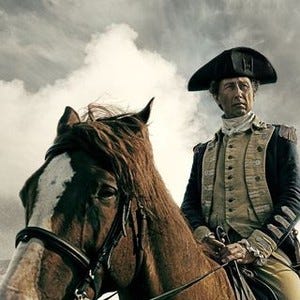
The series traces George Washington’s early ambition to serve as an officer in the British military, along with the setbacks he endured during the French and Indian War. Those failures may have redirected him toward his eventual role as the reluctant leader of a new nation.
One of the production’s greatest strengths is how it situates Washington’s personal growth within the broader struggles of an emerging republic.
Expert commentary from historians and scholars is skillfully interwoven with dramatic reenactments, some of them unflinchingly realistic in their portrayal of war.
Two contributors were a bit of a surprise: former President Bill Clinton, offering reflections shaped by his own experience in the office; and the late General Colin Powell, who speaks with quiet authority about America’s first great military leader.
In the end, “Washington” reminded me that the nation’s founding was neither inevitable nor tidy.
A president in motion
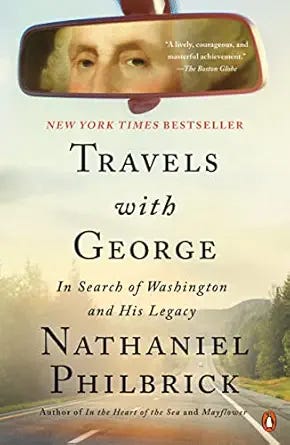
By sheer coincidence, I had just finished Travels with George, a combination travelogue and history book written by Nathaniel Philbrick, another of the TV program’s important contributors.
In 2018, Philbrick, his wife and their ever-present dog retraced, so far as modern roads allow, Washington’s journeys through the new states, beginning just before his inauguration and continuing through his first term.
The first leg took Washington from Mount Vernon to the new capital in New York City. Outside each town, he would step down from his carriage, change into his military uniform and mount a striking white horse. He entered amid clouds of dust kicked up by local cavalry units that insisted on escorting the new president. What followed was predictable and relentless: booming cannon fire, roaring crowds, lengthy speeches, endless toasts and fireworks.
Washington cultivated his image as a man of the people by lodging in public inns, even when they fell short of 18th-century standards. At times, he slipped away before dawn, well ahead of schedule, to avoid yet another round of ceremonial excess.
Philbrick also notes that Washington was seriously ill for several weeks after his inauguration. Still, he soon embarked on a month-long tour of New England—excluding Rhode Island, which had yet to ratify the Constitution, though Washington later made a conciliatory visit once it did.
There were quieter moments as well, including a discreet trip to Long Island, where Washington likely thanked members of the Culper Spy Ring (their story nicely depicted in the TV series “Turn”).
His most ambitious journey came late in his first term: a southern tour that began with an inspection of the Potomac River region where the future federal city would rise—a location that, Philbrick notes, stood to increase the value of Washington’s nearby landholdings.
From there, Washington traveled through the Carolinas to Savannah, getting a close-up look at an economy whose chief asset was enslaved people.
Philbrick does not soften this reality, nor Washington’s role as a Virginia slaveholder.
Travels with George offers a layered perspective: what Washington saw in the 18th Century alongside what Philbrick encountered nearly 250 years later. It’s worth the trip.
Colbert disappointment
I wasn’t a steady fan of Stephen Colbert’s “Late Show” but always thankful for his willingness to call out the Trump absurdities. Still, I can’t shake the disappointment I felt when Trump was Colbert’s guest 11 years ago, not long after Trump announced he’d seek the presidency.
I expected Colbert would serve up a pretty penetrating interview. He instead pitched softballs.
I’ve often wondered whether those gentle questions were the price of securing Trump’s appearance on Colbert’s show. Watch this short segment and judge for yourself:
Same problems, new day
I’ve been rewatching two older but enormously successful TV series: “Homeland” for its almost unmatched, intricately sustained suspense, and “The West Wing” for its reminder that even an imperfect occupant of the Oval Office can still serve the country well.
It also helps that I missed more than a few episodes the first time around.
What’s striking, though, is how little underlying issues have changed. The geopolitical tensions both series explored—”The West Wing” from 1999 to 2006, “Homeland” from 2011 to 2020—remain very much with us. Most notably, Iran’s pursuit of nuclear capability.
Consider this exchange from season six of “The West Wing” in which the U.S. president confronts the British ambassador:
“Damn it, John. The reform movement in Iran has real promise. Demographics are on our side.”
“Yes, you’ve been making that argument for some time now.”
“John, you’re going to drive the Iranian people right back into the arms of the hardliners!”
That was more than two decades ago.
The series’ lens was not limited to foreign policy. That same season also turned inward, taking up another issue that remains unresolved: drought and the precarious future of the Colorado River.
Two relentless cultivators
What a delight it was to watch two friends—men who might have been landscape designers in a previous life and are certainly fellow travelers in this one—compare notes and share a genuine appreciation for each other’s knowledge, experience and perspective.
While I plant a few flowers, these guys plant acreage.
I’ve written before about my neighbor Russel Francois. He’s the neighborhood overachiever who purposefully planted some trees upside down:
His property is so thoughtfully cultivated that it quietly lifts surrounding home values (and, at property tax time, blood pressures).
My C-minus landscaping efforts get rounded up to a B, just because Russel’s land is within sight. Even my weeds pass for rustic ground cover.
On this particular day, we visited my former boss, Ed Rust Jr. That’s Ed on the left, Russel on the right. I’m the guy safely behind the camera.
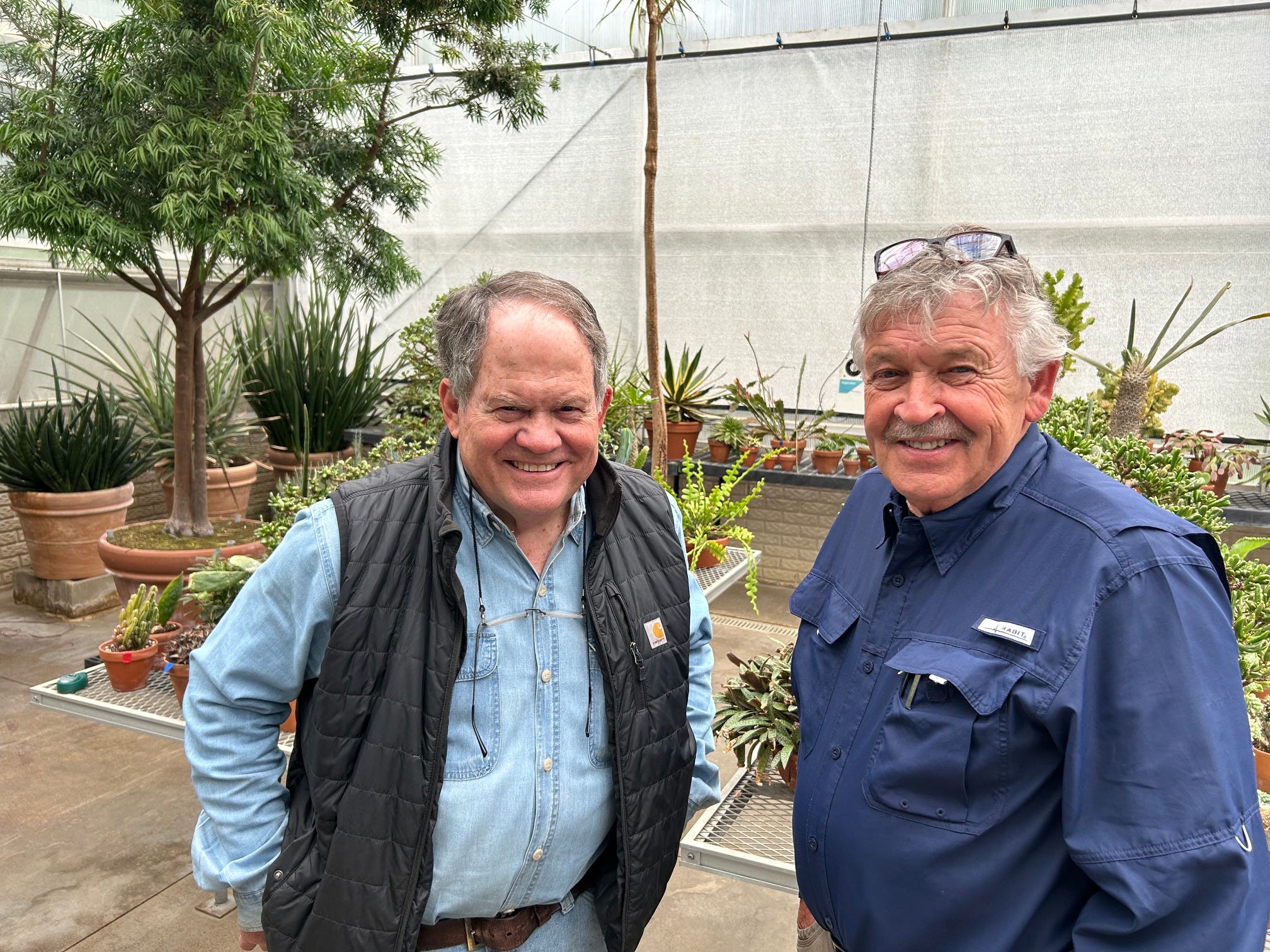
During his decades as head of one of America’s largest companies, Ed found both respite and counterbalance, not on a golf course, but in the steady, deliberate work of planting and nurturing hundreds of trees and their environs, supported by an impressive battery of equipment that, shall we say, reflects a commitment to land stewardship.
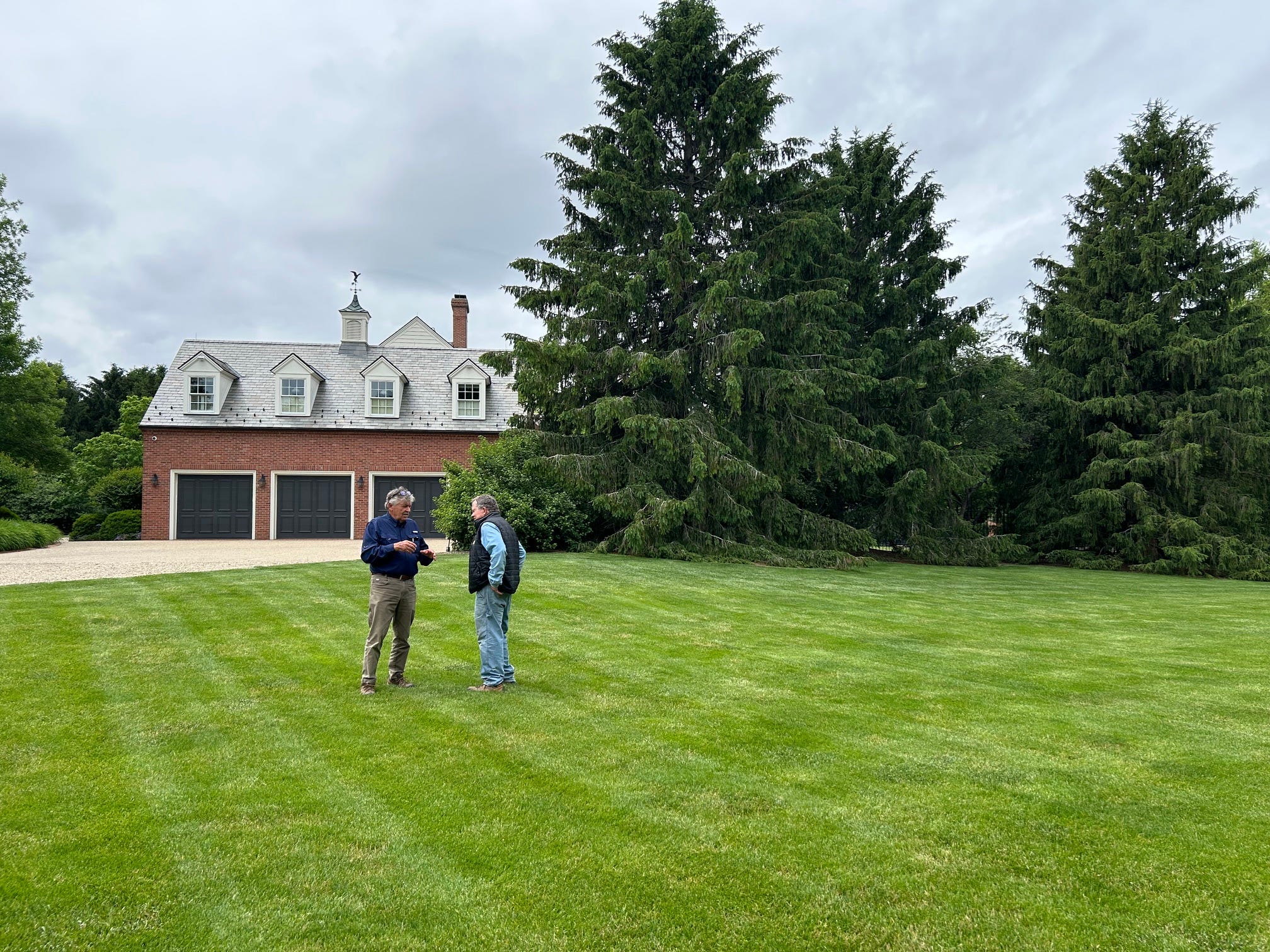
Watching Ed and Russel together, it becomes clear some people don’t just admire nature. They negotiate with it, improve upon it and occasionally rearrange it just for fun.
Sometimes even Mother Nature needs firm supervision.
Thanks for reading!
delightful - your hometown visit sounds very touching, and judging by the group, you are still appreciated. When we visit those rooted places, it's amazing the memories that return, but also, the emotions, which are much more than nostalgia, imagining the "home folks" as they appeared in our youthful eyes. If you are interested, I can share some revolutionary war books that are recent reads, some very divergent perspectives that opened my eyes. As we near 250, hopefully people will find deeper meaning than wrestling on the White House grounds...
Thanks for sharing this visit to your home town. What memories!