

AI terrifies me
And I don't know what to do about it
When railroads replaced canals and stagecoaches, there was upheaval, but new work followed. Laid-off canal hands became track layers and locomotive operators.
When automobiles displaced horses, harness and buggy makers found jobs in auto plants.
The pattern continued: Refrigerators ended the ice delivery business, but appliance manufacturing and repair took off. DVDs and streaming wiped out video rental stores, but skill-intensive occupations emerged in digital and media technology.
We like to think the same will happen with artificial intelligence. Maybe. But probably not.
In recent weeks, even AI evangelists who once downplayed risk have begun to sound urgently uneasy. And their concern isn’t just lost jobs. It’s the scale and speed of what’s coming, the potential implications.
I had thought about writing a piece urging Democrats to make AI policy a centerpiece of their 2028 platform. But that will be far too late. Congress slumbers at the switch while AI companies pour money into PACs, ready to pounce. Meanwhile President Trump has directed the Justice Department to block any state efforts to regulate the technology.
One AI insider finds himself on the outs with the rest of his industry. That’s Dario Amodei, CEO of Anthropic, a leading AI company. He’s been pushing for tight federal regulation. And now he’s warning that the technology is moving ahead much faster than anyone expected, predicting AI is about to “test who we are as a species.”
One of his safety researchers quit this month, claiming “the world is in peril.”
I get why a patchwork of regulations in 50 states would be unwieldy and inimical. But at a time when Congress can’t find ways to legislate far simpler matters, and when Trump (whose super PAC got $25 million from Open AI’s president and his wife) insists on giving AI maximum freedom, we have a critical problem that goes way beyond jobs, though even just the speed of the change may severely disrupt our economy.
There’s a chance, I suppose, that it’s all just hype. But there’s an even better chance we need to worry how we keep AI from replacing human judgment.
Anthropic recently posted this on its website: “AI is being adopted faster than any technology in history, and the window to get policy right is closing. Yet there are no official guardrails in place and no federal framework on the horizon.”
This scares the hell out of me, and I don’t know what to do about it.
I’m not sure anyone else does either.
Playing to the camera, ignoring the Constitution
Years ago The Chicago Tribune published a letter I wrote lamenting how latchkey kids could come home from school, flip on the TV and soak up the moral sludge served daily on “The Jerry Springer Show.”
That memory resurfaced with the recent death of sociologist Vicki Abt, who about the same time got a lot more attention when she very publicly called out the rot spreading through daytime talk TV. Her critique was so incisive that even Oprah Winfrey did some soul-searching, vowing to “disassociate ourselves from the trash pack.”
If only that kind of reckoning were contagious.
Watching U.S. Attorney General Pam Bondi’s recent combative, made-for-TV performance before a congressional committee, it was easy to see the influence of “reality” television—the shouting matches, the feigned indignation, the camera-ready contempt.
Her old professors at Stetson’s law school were surely embarrassed, possibly disgraced.
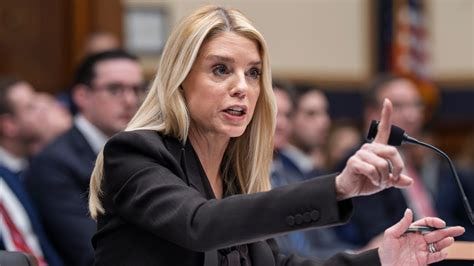
Bondi proved herself less a public servant than a product of our national entertainment complex. It was like she was auditioning, trying to please an audience of one, someone who watches a lot of television near the Oval Office. You know, the guy who was himself a reality TV star?
As Dr. Abt put it: “You watch enough of these shows and you begin to think everybody’s sleeping with a chicken.”
Attorney General Bondi’s performance was shameful.
Freshmen entering college this fall were about nine years old when Trump descended that golden escalator. What a tragedy if their view of how government should work—about how public servants should behave—has been defined by what’s followed.
Morning Miracle meltdown
It was with certain sadness that I consumed the news of severe cutbacks in the staff of The Washington Post, once one of America’s greatest newspapers.
Roughly 300 of the newspaper’s 800 journalists got pink slips this month.
My friend and former Post columnist Dave Kindred saw it all coming 16 years ago when he wrote Morning Miracle: A Great Newspaper Fights for Its Life.
Back in 1968, when I was testing my reportorial skills in the halls of Congress, Washington, D.C., had three daily newspapers. The Washington Star swallowed The Washington Daily News four years later, then went bankrupt in 1981, ending 128 years of publication and leaving the The Washington Post as the city’s lone daily. Jeff Bezos bought it in 2013—three years after Morning Miracle appeared.

Kindred’s book remains one of my favorites, not only for its vivid storytelling but because it captures both his love of newspapering and his clear-eyed awareness of the struggles it would face. Or as better put by another famed sportswriter, Frank Deford: “Morning Miracle is one of those wistful love stories filled with as much foreboding as tenderness.”
A kind review and deeper reminder
Judith Valente—author of multiple thought-provoking books, including Atchison Blue and, most recently, The Italian Soul—has posted a generous review of Broadcast Live that carries a message worth sharing, one related to the previous item. I offer it here, with some embarrassment, because that message matters:
A Life Well-Lived Told By A Superb Storyteller
“Broadcast Live” is an insightful chronicle of what it was like to be alive in the mid-20th century, and what it has so far been like to live in the first quarter of the 21st century. It is an intriguing memoir of a particular life -- a life that was linked to significant people and events. That is because author Steve Vogel was a broadcast journalist in a time when people still widely listened to radio as a community experience (and not podcasts out of individual earphones), got their news from common sources, and supported their local newspapers. He later joined corporate America, seeing things from “the other side of the aisle” as journalists would say. Along the way he also wrote a book about a tragic and controversial murder in his community that became a bestseller. If that wasn’t a full life, a life well-lived, I don’t know what is. This book, however, isn’t just a look backward, as entertaining and well-written as the personal vignettes in it are. Just as importantly, it tells us something about ourselves today and what we have lost in retreating more deeply into our individual silos in the ways we gain information and communicate with others. Reading this book might inspire you to support your local newspaper as an important community resource. It might make you want to turn on your radio at home to share hearing the sound of another human voice with others. It will certainly make you think about what constitutes community and how you might become a bigger part of helping your community to cohere. That was another of Steve Vogel’s major roles and major contributions, building community. In that sense, his life and his memories are guideposts for us all.
Threaded connections
If you’re in the Phoenix area and plan to attend “Art at Sun Lakes” next Saturday, March 7th, make sure you stop by booth 17 (among the 97). That’s where you’ll find Mary with her beautiful quilts and other fiber fashions.
And her husband, too. I’ll be scanning passers-buy (oops, passers-by), always on the lookout for familiar faces from Illinois.

A celebration of life and friendship
Actually, as I write this, I’m in Illinois, where I attended a celebration of life for my longtime friend and former colleague, Phil Supple. I was honored to speak at the large gathering, which fittingly took place on his birthday.
Much of Phil’s career was spent as news director at WEEK-TV in Peoria, Ill., then one of the nation’s stronger mid-market newsrooms. Many of his former Channel 25 colleagues were there today, including Tom McIntyre, the station’s principal news anchor for decades.
Phil was remembered as someone you were always glad to see—one of those rare people whose presence always made a day better. That’s what makes missing him so much harder.
From King’s shadow to his own spotlight
It seems fitting Jesse Jackson left us during Black History Month.
I interviewed him a couple times. He was an inspiring force with great oratory skills. But I was always wary of how he elbowed his way to where the TV cameras were focused.
Jackson clearly saw Martin Luther King Jr., whom he worked for, as the father he never had. And that, along with Jackson’s self-promotion, produced resentment inside King’s inner circle.
My interaction with Jackson came in the 1980s, between his two presidential campaigns and after he had formed the Rainbow Coalition. I most recall how I interviewed him just moments after he had publicly and broadly criticized the insurance industry for race-based unfairness (“redlining”) in pricing and coverage.
He knew I was from the downstate Illinois community that was home to two large insurance companies. In my one-on-one interview, I gave him every chance to criticize them specifically. He instead avoided mentioning their names. Only later did I recognize the pattern: Apply public pressure but keep the door open to receiving company grants for organizations led by him and his associates.
It was not long after he had ignited the 1984 Democratic National Convention with his “patchwork quilt” speech.
“Our flag is red, white and blue, but our nation is a rainbow — red, yellow, brown, black and white — and we’re all precious in God’s sight. America is not like a blanket — one piece of unbroken cloth, the same color, the same texture, the same size. America is more like a quilt — many patches, many pieces, many colors, many sizes, all woven and held together by a common thread.”
Some say Jesse Jackson made Barack Obama possible.
She stirred a movement
And to close out Black History Month, consider this question: Who was the single most influential force behind President Lyndon Johnson’s decision to sign the landmark Civil Rights Act of 1964?
Martin Luther King Jr.? Hubert Humphrey? Everett Dirksen?
According to author Alex Prud’homme, it might have been someone far less known: Zephyr Wright.
Wright was hired as a cook and maid by the Johnsons at their Texas ranch before LBJ ever ran for Congress. Her husband, Sammy, worked as their driver. When Johnson was elected to the House and later the Senate, the Wrights followed the family to Washington, often driving between D.C. and Texas several times a year.
But the long trips came at a cost. As Prud’homme recounts in Dinner with the President, the Wrights — both Black — were routinely denied service at restaurants, hotels and gas stations. Eventually, Zephyr had had enough.
“When Sammy and I drive to Texas and I have to go to the bathroom, like Lady Bird or the girls, I am not allowed to go,” she told Johnson. “I have to find a bush and squat. When it comes time to eat, we can’t go to restaurants. We eat out of a brown bag. And at night, Sammy sleeps in the front seat with the steering wheel around his neck while I sleep in the back. We are not going to do it again.”
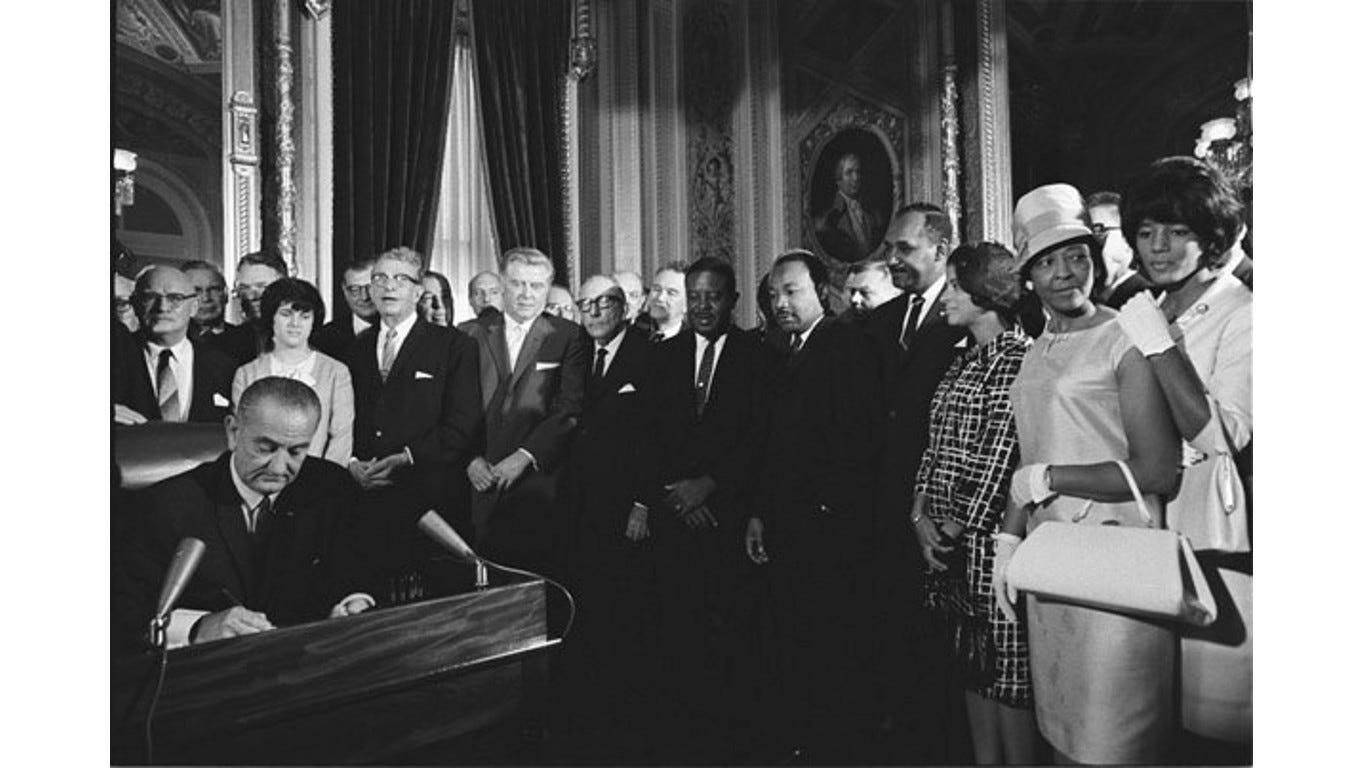
Years later, when Johnson signed the Civil Rights Act, he made sure Mrs. Wright was in the room. (That’s her in the hat.)
After putting pen to paper, he handed her one of the pens he had used and said, “You deserve this more than anybody else.”
Another strike, same script
I can’t send out this end-of-month Substack without acknowledging the overnight news: President Trump has once again ordered U.S. forces to strike Iran. He says the goal is to end Iran’s pursuit of nuclear weapons — though just eight months ago, he assured us our earlier attack had “obliterated” that same program.
A couple of reminders, Mr. President: Only Congress can declare war, and you’ve barely consulted its members. You barely touched on the matter at this week’s State of the Union address.
This all feels like theater, Mr. President. And it’s not helping your campaign for the Nobel Peace Prize.
Thanks for reading.
Great insight on AI -- read the latest Atlantic - a devastating article, particularly about the pace of technological change -- https://www.theatlantic.com/magazine/2026/03/ai-economy-labor-market-transformation/685731/ Also, great insight of Pam Bondi, and I love the story about LBJ's housekeeper & driver. Well done